





A national exam preparation platform, built from zero to paying students
A founder spotted a gap: students were hunting for good exams and corrections across Facebook groups, private libraries and private teachers. Working as his MVP development company, we turned that idea into one platform with teacher-written content, protection that has held up in production, and SEO that brings the students in.
- Client
- National exam preparation platform (anonymous)
- Team
- 5 to 6 people from HannibalDev
- Timeline
- 12 months build, 6 months optimisation
- Scope
- Product, UX, secure viewer, admin, SEO, analytics
- Today
- Ongoing monthly missions
- Google clicks
224k
organic clicks in the last 12 months
- Impressions
3.83M
search impressions over 12 months
- Unique users
127.6k
unique users across 226k tracked sessions this year
- Leaks
0
document leak incidents in 18+ months live
- Active users
50→75%
share of users staying active, year over year
- Last 30 days
+64%
active users vs. the previous 30 days
Sources: Google Search Console, Microsoft Clarity and Google Analytics, September 2026.
A good idea in a market where one leaked file ends the business
The client already ran another business and saw this opportunity from inside it. Students preparing for national exams needed past papers with detailed corrections, but the material was spread across Facebook groups, private libraries and private teachers. Quality was uneven, and finding the right exam for the right subject and term took a lot of searching.
The first concern he brought us was protection. In a national exam market, everyone studies the same programme. If one paid document is downloaded or screenshotted and posted to a student group with 500,000 members, half the country has it within a week. A business built on that content would be gone in a month or two.
Most competitors respond with copyright warnings. Those don't stop anyone, and you can't take hundreds of anonymous people on social media to court. For a worldwide course or a generic digital product, downloads may be an acceptable cost. For a platform like this, protection decided whether the business could exist at all.
One place to study, one place to run the business
A library organised the way students study
We structured the library to match the student's real school year: pick your level and section, then a subject, then the term, then a control or synthesis exam. Every exam opens in the same interface as its correction, across every subject and section.
- Up to 9 subjects per section, from mathematics to philosophy
- Exams grouped by term and by exam type
- Statement and correction one click apart
- Content written by teachers, not collected from random uploads
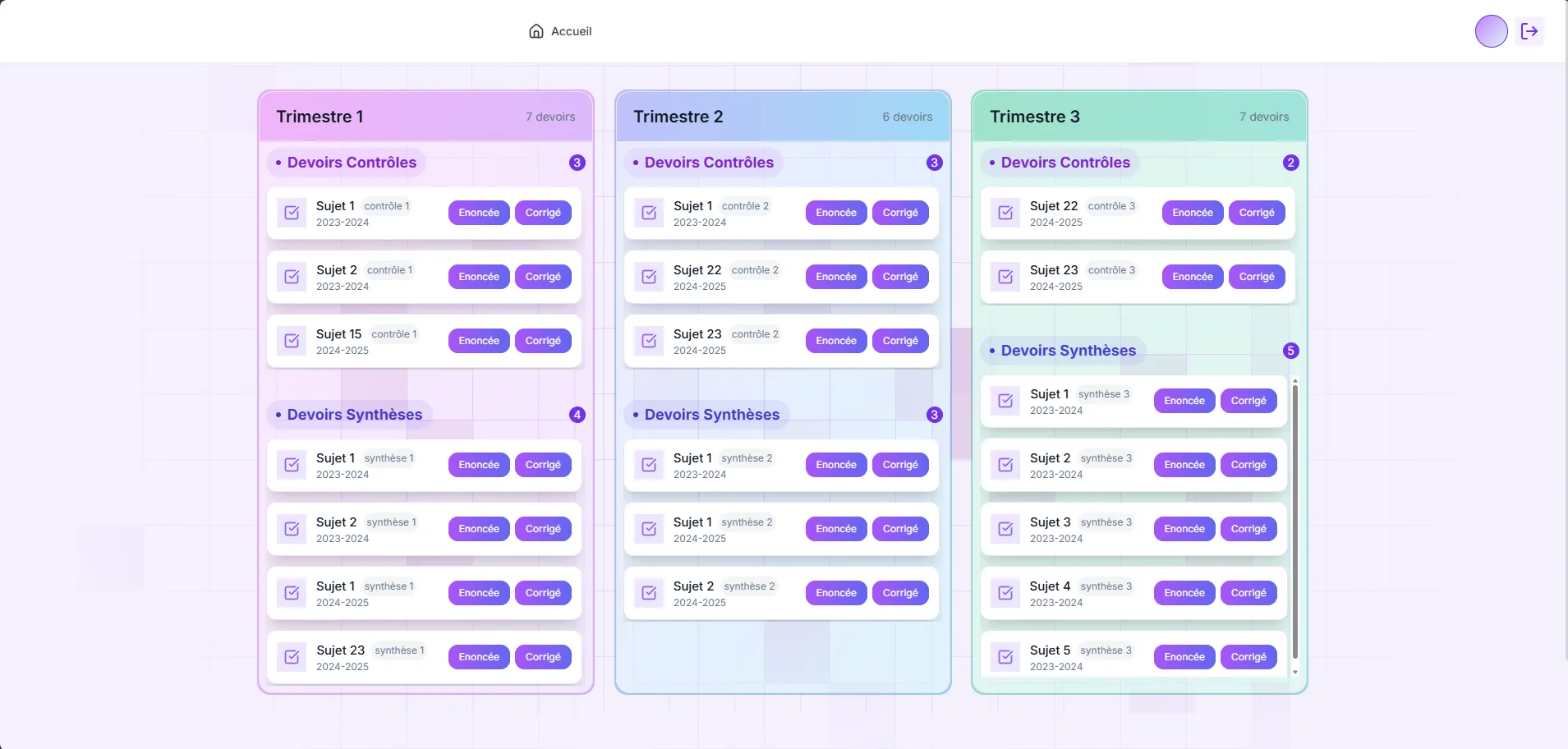
One subject, three terms, every control and synthesis exam with its correction.
A viewer that lets students read, and nothing else
We spent more research time on this than on any other part of the project. We tested standard web viewers, PDF readers, Chrome-based approaches and a mobile app. Each had a way around it. The answer was a DRM-based document pipeline that runs in Microsoft Edge: students can read everything, but they can't download it, and screenshots come out black.
Each page also carries a personal watermark, so every view is tied to one account. The client asked us to keep the technical details private, so we share the result instead: more than a year and a half in production, with many active students, and no leak incident.
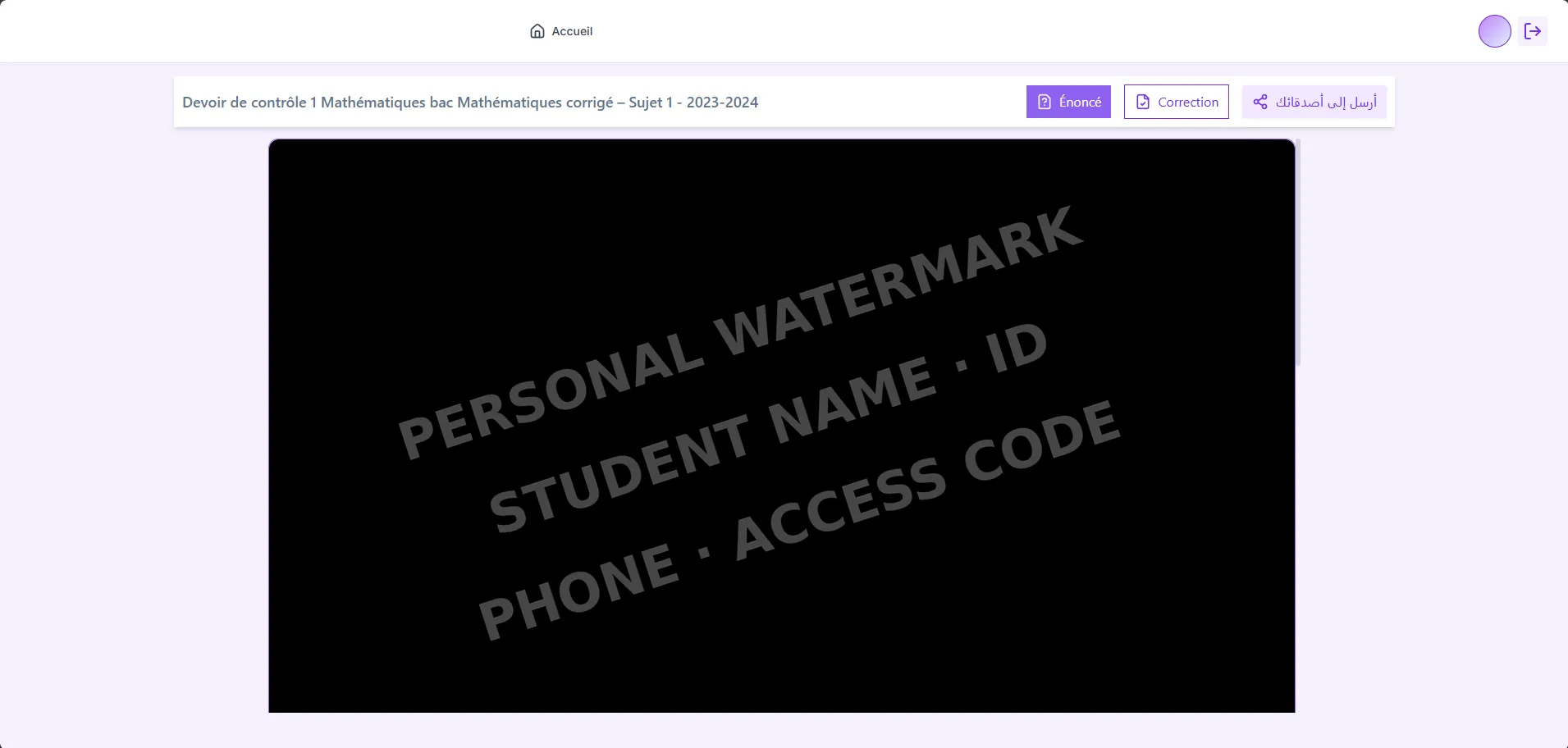
What a screenshot of a protected exam looks like. The real watermark shows the student's identity; it is replaced here.
An admin cockpit that follows every step
The client's favourite tool is the one that follows each user from first touch to active subscriber, whether they came from Google, word of mouth, an AI assistant or a brand search, and every step after that. The client makes his decisions from this data.
- User management with device, browser and verification status
- Video completion rate for each user
- Subscriptions, CRM and team roles for his staff
- Bulk SMS to bring students back each school year
- Built-in surveys on features and pricing
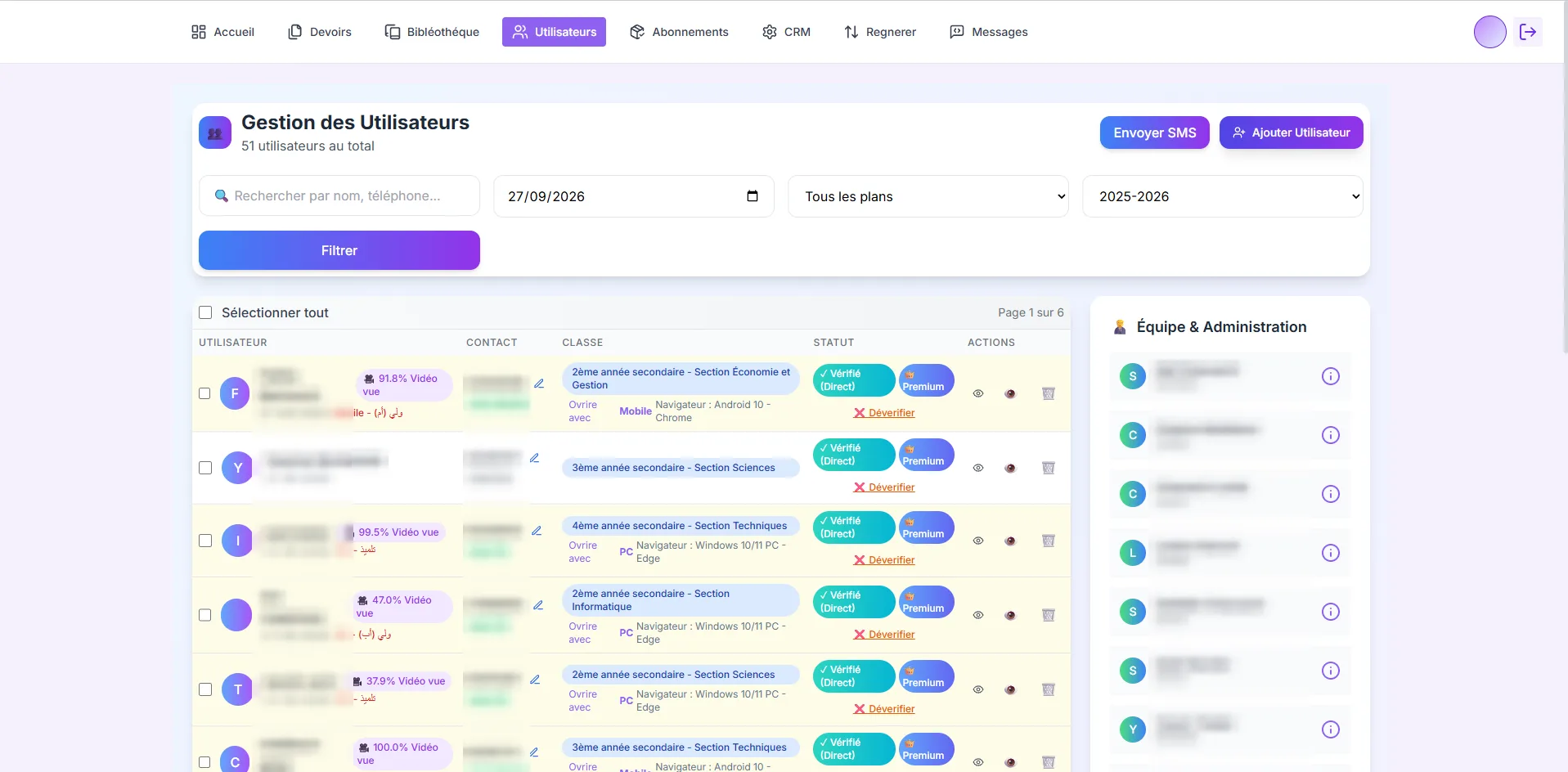
User management. Names and phone numbers are blurred.
We found the flaw in our own security, and told the client the same day
We had confirmed the first version of document protection. The client was happy and we had moved on to other features. Then one of our developers discovered that a single browser setting in Chrome could switch our protection off and expose every document.
We could have stayed quiet and hoped nobody else noticed. We told the client right away. He understood, and we spent two more months rebuilding the protection until it held. It was a stressful stretch, and it is the part of this project we are proudest of.
Months 1–12
Research, product design, secure viewer, library and admin tools
+2 months
Protection rebuilt after we found our own bypass
Months 13–18
Conversion and SEO optimisation from real usage data
Now
Monthly missions as the platform scales
Is there a hard problem at the centre of your idea?
We work through the difficult part with you: the feature nobody else has built, the risk that could stop the project, the number that has to move. Leave your number and we'll call you to talk it through.
SEO brings students in, and data keeps them
Our team handled SEO end to end: keyword research before a single page existed, then the build, audits with SEO tools, technical fixes, on-page work and a mobile version that performs as well as desktop. Year over year, average position improved by one to one and a half places on almost all target keywords, and clicks and impressions grew as the site ranked for more queries.
If you are comparing MVP development companies, this is what end-to-end means to us: web apps development services first, then the growth work that makes the product pay. It is also what separates a bespoke software company from a team that hands over code and leaves.
Links are the next step. In a niche this specific, random backlinks do more harm than good, so we only work with well-known websites in the same country. It costs more, and the client has chosen to invest in it.
- Avg. position
5.8
average Google position over 12 months
- CTR
5.9%
average click-through rate from search
- Engagement
4.94
pages viewed per session
- Scroll depth
80%
average share of each page read
- Active time
3.5 min
of focused activity per session
- Sign-ups
19.8k
sessions that completed the sign-up funnel this year
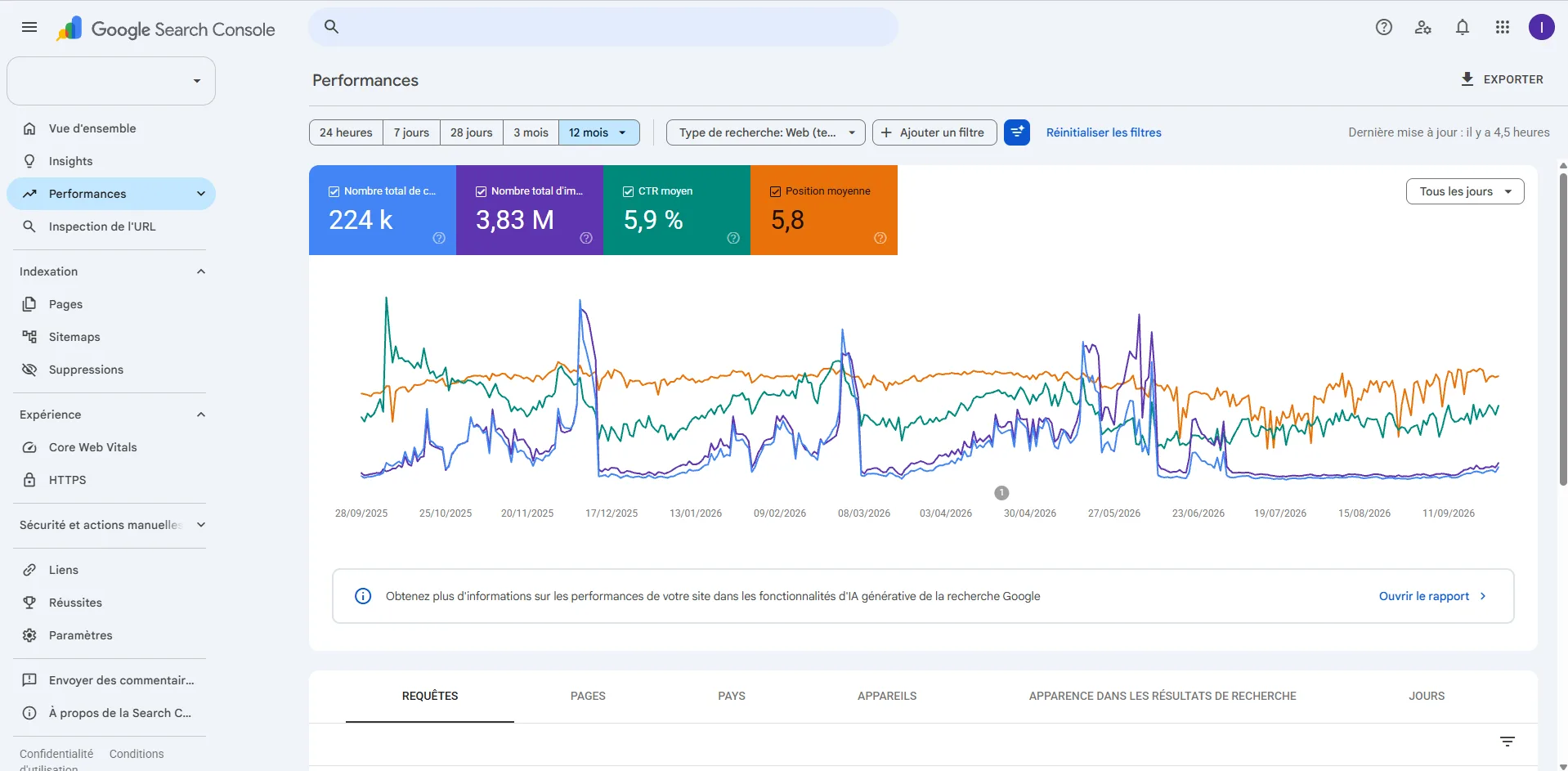
Search Console, last 12 months. Peaks follow exam periods. 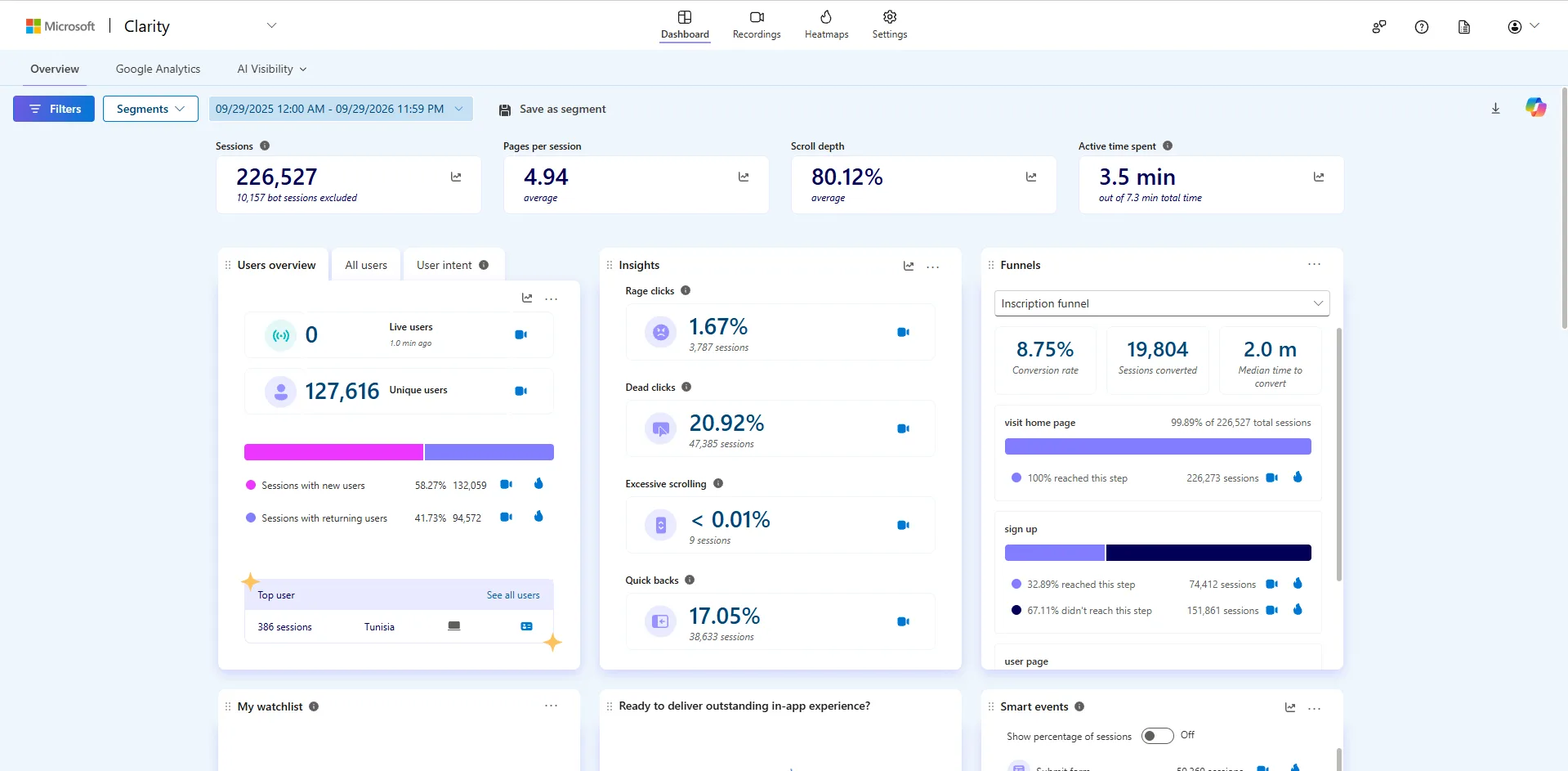
Microsoft Clarity, this year. We use its recordings and funnels to decide what to change.
From 50% to 75% of users staying active
We tracked the full path, from a Google result to the right exam page to the subscription page, and optimised one step at a time. Each change was tested and measured before we moved on to the next.
Fewer clicks to the right exam
A student landing from search reaches their exact subject and term, and then the subscription page, in fewer steps.
A shorter sign-up form
We cut the fields students fill in down to what the platform really needs.
A short video that moves people to Edge
Most visitors arrive on Chrome. A short animated video with a clear hook plays automatically and explains the switch. It is watched over 80% on average, and 75 to 80% of desktop visitors move to Edge.
Reminders for everyone else
Visitors who stay on Chrome get a follow-up message. Mobile users are invited to continue on a computer with Edge.
Coming back every school year
SMS campaigns bring students back at the start of each year and before exam periods.
Asking students directly
In-app surveys on features and pricing feed the next offers, such as a final-exam pack.
2,211 students told us what they would pay
We built a pricing survey into the platform. A quarter of respondents said they are ready to pay, and their answers show which price points attract them. The client now plans new offers from this data instead of guessing.
- Responses
2,211
students surveyed
- Ready to pay
25%
555 students ready to pay
We also plan for the students who want something different. About 5 to 7% still ask for paper copies. We helped the client answer them in a way that keeps them on the platform.
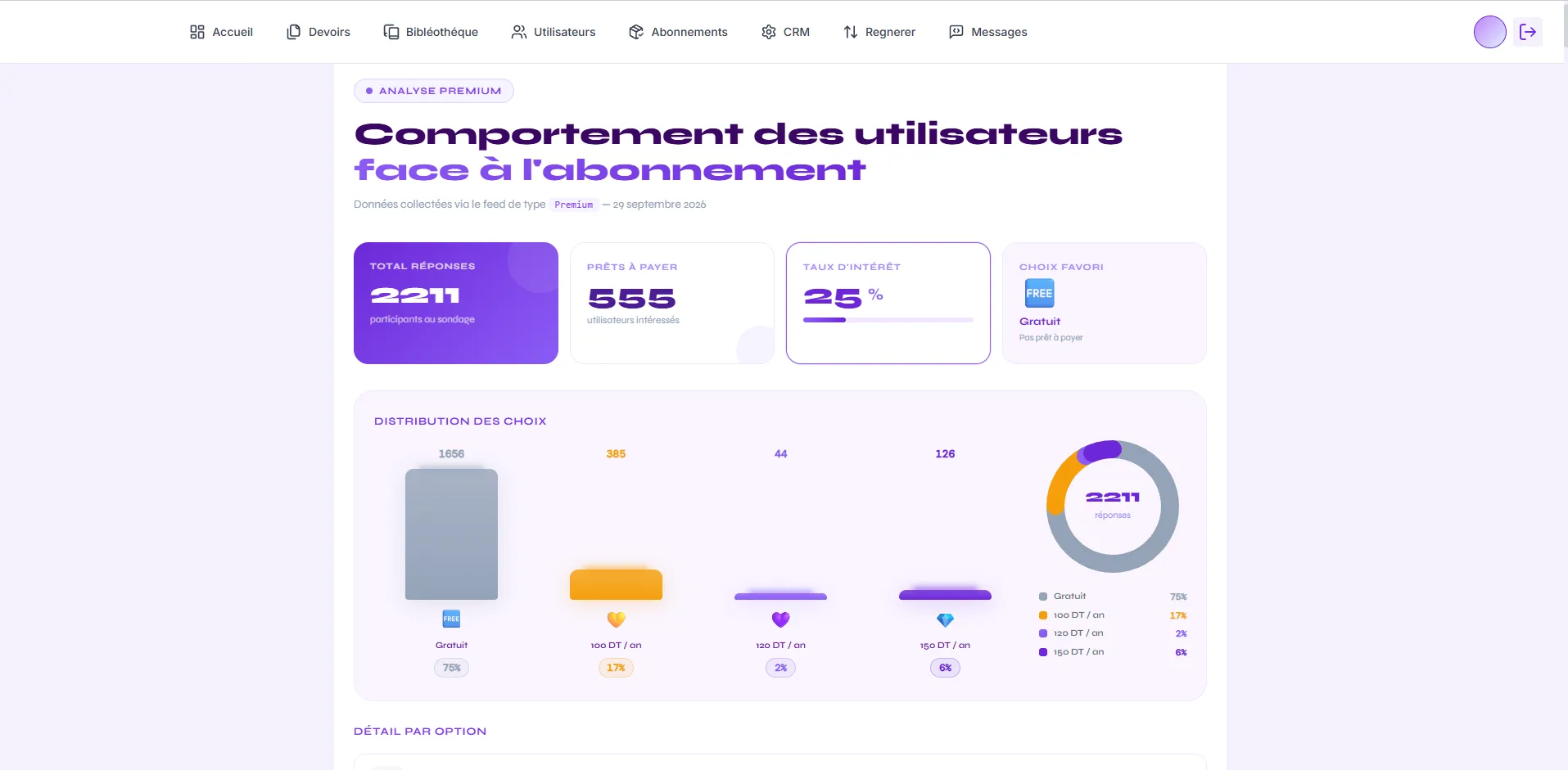
The pricing survey dashboard we built for the client.
We treat the project as if it were ours
No stopwatch on every hour
We stay flexible and work closely with the client. We follow the numbers and the results until the project succeeds. It is how we work, whatever the size of the client.
The market decides the solution
Document protection was right for this market. Your project may need something else entirely, from custom software development for small business to a full platform. We study the market first, then build what it needs, whether that's education, healthcare or industry.
Data at every step
We read user behaviour from the database, from Clarity and Analytics, and from tools we build ourselves, then turn it into decisions the client can act on. CRM software development services and analytics come from the same team.
A relationship that continues
Once the platform matured, the client thought about hiring an in-house team. We offered a better option: continued monthly missions at an affordable price. He chose to stay with us.
I see my platform as limitless. The product is proven and nobody complains about it. Now I just need to reach every corner of the market.
The same build for an elearning platform or enterprise elearning
A structured library, a viewer that protects your content, an admin cockpit that follows every user, and analytics that drive decisions: that is also the core of an elearning platform for a training company, or enterprise elearning for staff across many sites.
An enterprise app development company that starts small
As an enterprise app development company, we still start with the hardest problem and two or three features, then scale. If you need to hire an app developer UK teams can work with day to day, the developers you meet on the first call are the ones who build it.
Let's take your project from idea to market
Strategy, product, complex custom features, SEO and analytics, all from one team that stays after launch. Whether you need a first version or a partner to scale a live product, book a call and tell us what you want to build.
More case studies
Frequently asked questions
Good MVP development services find the one problem that decides whether the business can exist, solve it first, then build the rest around it. For this platform it was document protection. We researched it longer than anything else, launched with analytics in place, and grew the product from real usage.
Here we used a DRM-based document pipeline that runs in Microsoft Edge: students can read everything, but can't download it, and screenshots come out black. Each page carries a personal watermark. The client asked us to keep the technical details private; the result is 0 leaks in 18+ months.
12 months to build with a team of 5 to 6, including two extra months to rebuild protection after we found our own bypass, then 6 months of conversion and SEO optimisation. Today we run monthly missions.
Yes. Once the platform matured, the client considered hiring one or two people in-house with coaching from us. We suggested continued monthly missions at an affordable price instead, and he chose to stay with us.
If you want to hire an app developer UK founders can rely on, look for people who will stay after launch and measure results. We don't put a stopwatch on every hour. We work closely with the client, treat the project as ours, and follow the numbers until it succeeds.
Yes. The same pieces, a structured library, a protected viewer, an admin cockpit and analytics, fit an internal elearning platform or enterprise elearning for staff training, with roles and reporting per team.